Typical moving-time planning ranges
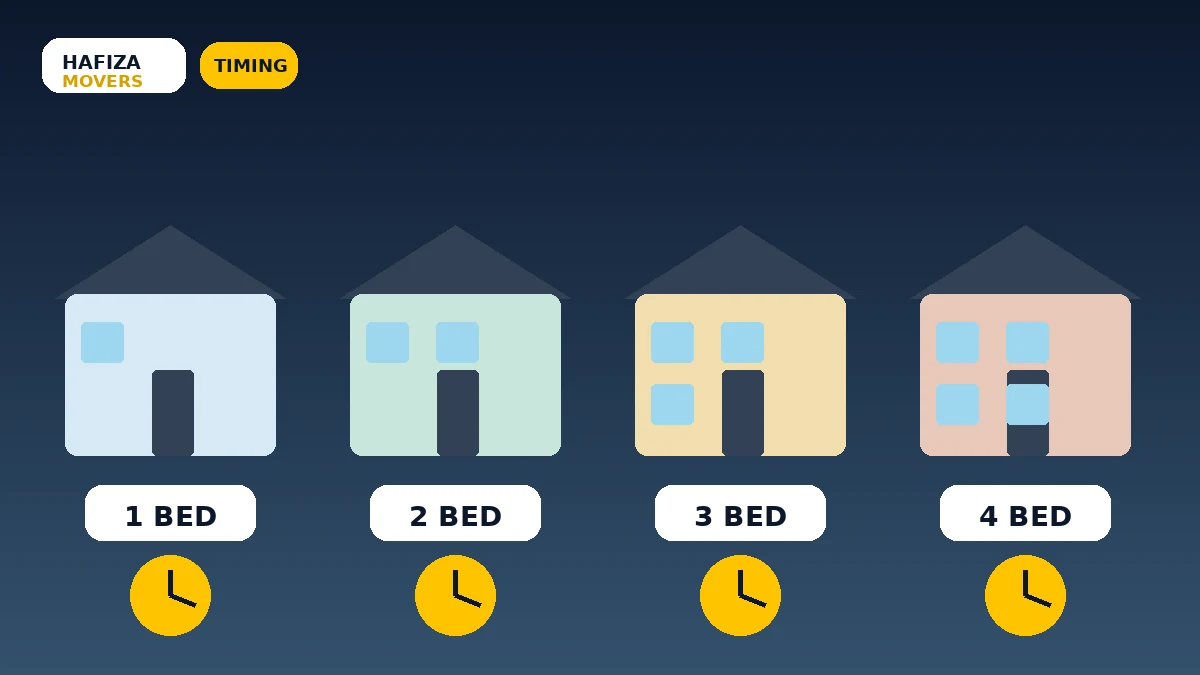
| Home size | Broad working range | Common truck/team planning | What can push it longer |
|---|---|---|---|
| Studio or 1 bedroom | 2-4 hours | Often 2 movers and a small-to-medium truck | Apartment lifts, long corridors, loose items or difficult parking |
| 2 bedrooms | 3-5 hours | Often 2 movers; larger volume may benefit from extra labour | Bulky furniture, stairs, garage contents or multiple stops |
| 3 bedrooms | 5-8 hours | Team and truck depend strongly on inventory and access | Large box count, dismantling, outdoor items and travel |
| 4 bedrooms | 7-10+ hours | A larger truck and additional movers may reduce repeated trips | High volume, heavy items, poor access, storage or split loads |
A bedroom count is only a starting point. A minimalist three-bedroom townhouse can be faster than a heavily furnished two-bedroom apartment with a small lift and distant parking.
The moving-time formula
Loading time + travel and traffic + unloading time + access or waiting delays + extra services.
Loading and unloading are usually the largest parts of a local move, but repeated walking distance can quietly add time. Every box or furniture item travels from its room to the exit, through common areas, to the truck, then through the new property in reverse.
Eight factors that change how long a move takes
- Total volume. Count boxes, furniture, appliances, garage and outdoor items rather than relying only on bedrooms.
- Packing readiness. Sealed, labelled boxes and cleared pathways are faster than loose items and unfinished cupboards.
- Stairs and lifts. Small or shared lifts, stair flights and waiting windows add repeated handling time.
- Parking distance. A truck outside the door is different from a long carry through a basement or busy street.
- Dismantling and assembly. Beds, tables, desks and complex furniture require time and suitable tools.
- Heavy or fragile items. Safes, pool tables, large mirrors and oversized furniture need special planning.
- Travel and traffic. Distance, route, tolls, peak traffic and additional pickup points affect the schedule.
- Team and truck capacity. More labour or the correct truck may reduce trips, but the best plan depends on access and volume.
Example Melbourne moving scenarios
Prepared 1-bedroom apartment
Boxes sealed, lift booked, loading bay confirmed, furniture measured and both properties close together. This may sit near the lower end of the range.
1-bedroom with difficult access
Street parking, long corridor, shared lift and loose belongings. The same number of rooms can take substantially longer.
3-bedroom family home
Normal furniture, garage items, labelled boxes and direct driveway access. Inventory and truck capacity will determine whether one load is practical.
4-bedroom move with extras
Outdoor furniture, heavy items, dismantling, storage stop and stairs. This can extend beyond a standard working day or require staged planning.
How to reduce moving time without rushing care
- Finish packing and seal boxes before the moving team arrives.
- Use clear room labels and place matching signs at the new property.
- Dismantle only suitable furniture in advance and keep hardware labelled.
- Reserve lifts, loading bays and parking where required.
- Clear hallways, entrances and driveways.
- Move small personal items into boxes instead of leaving loose piles.
- Identify fragile and heavy items before loading begins.
- Decide furniture placement before the truck reaches the new home.
Professional packing and unpacking support can reduce unfinished packing, while loading and unloading help may suit customers who already have transport.
Information to send for a realistic time estimate
| Detail | Useful example |
|---|---|
| Inventory | Approximately 35 boxes, sofa, two beds, dining table, fridge, washer and balcony setting. |
| Pickup access | Level 6 apartment, booked goods lift, 20-metre corridor, loading bay height limit. |
| Delivery access | Townhouse with driveway, one internal stair flight and narrow bedroom door. |
| Special work | Dismantle two bed frames, wrap a large mirror and collect one item from storage. |
| Timing | Keys available from 10 am and building lift booked from 11 am to 2 pm. |
Use these details to request a Melbourne moving quote. For the wider cost structure, read Removalist Quotes Explained.


Written and reviewed by Hafiza Movers and Packers Melbourne
This guide reflects the practical questions our booking and moving team uses to plan local house, apartment, furniture and office moves: inventory, access, parking, timing, fragile items and the right truck.
Read customer feedback · See recent Melbourne moves on Instagram
Useful sources and further reading
Frequently asked questions
How long does a 1-bedroom move take?
A prepared local 1-bedroom move with reasonable access may take around 2-4 working hours, but lift, parking, distance, volume and loose items can extend it.
How long does a 3-bedroom house move take?
A broad planning range is around 5-8 hours. Large inventories, stairs, outdoor items, dismantling, travel and extra stops can make it longer.
Do more movers always make a move faster?
Additional movers can help on suitable jobs, but access, truck capacity, coordination and the amount of work determine the best team size.
Does travel time count in a removalist booking?
Charging methods vary. Ask when chargeable time starts and stops and how travel or call-out charges are calculated.
How can I get a more accurate time estimate?
Provide a major-item list, approximate box count, access photos, stairs or lift details, parking distance, travel route and special services needed.